
A&M-Victoria professor connects medieval research with teaching, service
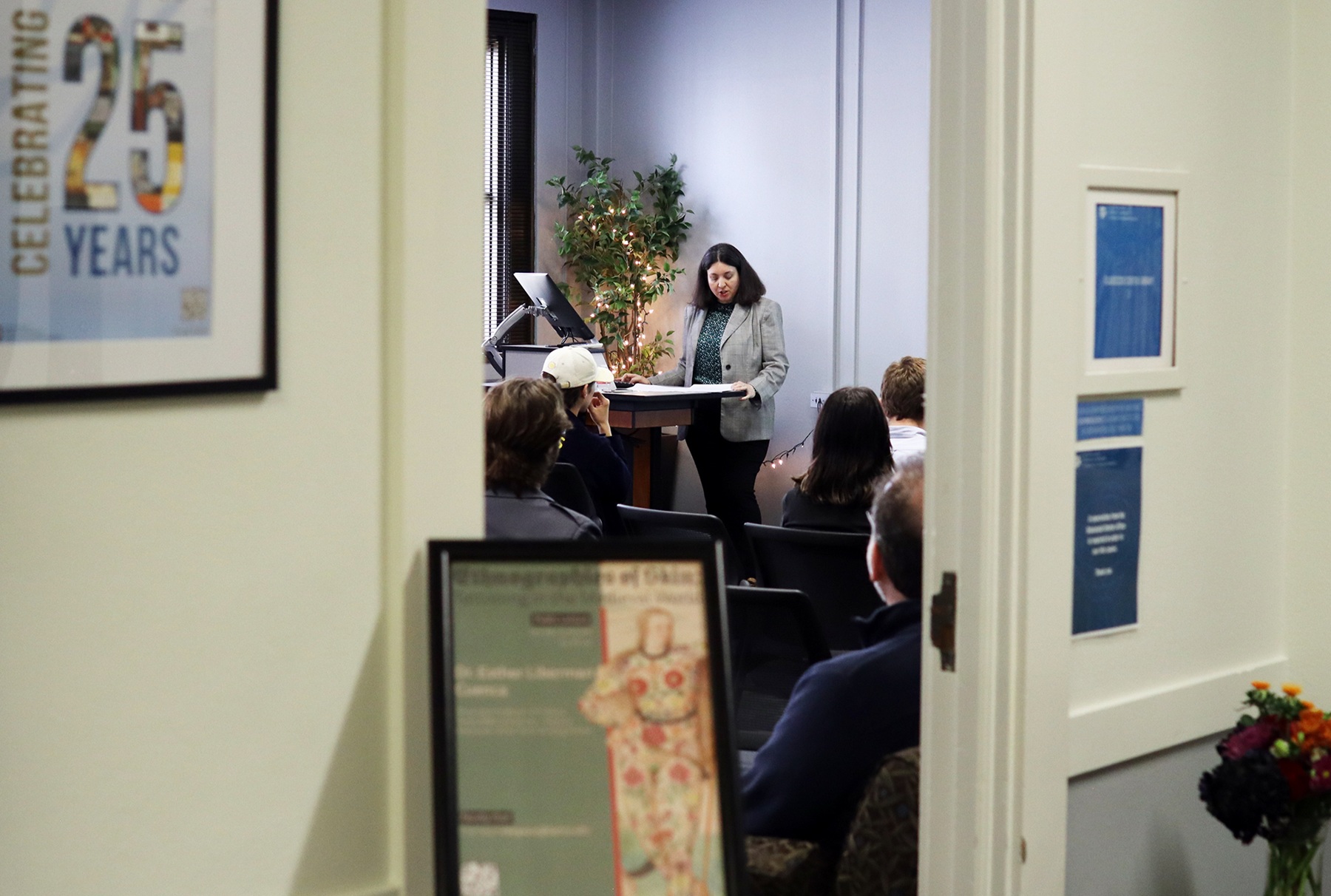
From archival research on medieval tattooing, to teaching graduate students and receiving recognition for her first book, Esther Cuenca has made scholarship and service central to a busy semester.
Cuenca, an associate professor of history and chair of the Department of Social Science at Texas A&M University-Victoria, recently came back to campus after spending a week at Texas A&M University in College Station doing what she has built her career around: researching the past, sharing knowledge about that past, and helping other scholars develop their work.

"It has been an exciting and impressive semester for Dr. Cuenca, and I couldn't be happier for her accomplishments and all the intellectual contributions she brings to the field," said Dolores Guerrero, interim dean of the College of Liberal Arts & Social Sciences. "We are incredibly fortunate to have faculty members who actively contribute to their disciplines, as well as engage with colleagues and institutions beyond our campus, and I look forward to seeing what Dr. Cuenca will tackle next."
The weeklong visit to the flagship campus was part of a Glasscock Center Short-Term Visiting Fellowship at Texas A&M’s Glasscock Humanities Center. Sponsored by Che Yeun, an assistant professor of history at Texas A&M University, the fellowship brought Cuenca to campus from Oct. 25 to 31. During the fellowship, Cuenca collaborated with members of A&M’s history department, presented her research, and worked with students and faculty members.
“I got to interface with the students there, who are excellent,” Cuenca said. “It was a very productive and wonderful fellowship in which I got to network with different faculty members at Texas A&M.”
At the center of the visit was a public lecture she gave titled, “Ethnographies of Skin: Tattooing in the Medieval World,” which she delivered on Oct. 28. The talk drew on Cuenca’s forthcoming book, “Body Art and Tattooing in the Global Middle Ages”, which is to be published by Cambridge University Press next year.
Cuenca’s research challenges a persistent assumption about the medieval period that most people hold: that medieval people, including Christians, did not tattoo their bodies. Working through various historical sources, she found evidence that tattooing was used for a range of purposes, sometimes to signal religious faith and community belonging, and sometimes to mark certain people as enslaved, criminal or incarcerated.
The significance, Cuenca said, lies in what body art can reveal about the societies that practiced it. Tattoos were not simply decorations; they could communicate identity and status to others, she said. Most histories of tattooing have focused on modern times, Cuenca said, which leaves medieval tattooing largely underexplored, and her research hopes to fill that gap. Much of the research and writing for the book took shape during a semester-long fellowship at the archives of The Huntington Library, Art Museum, and Botanical Gardens in California in fall of 2025, Cuenca said.
In addition to the public talk, Cuenca taught a class on tattoos and medicine in Yeun’s history of science course, where she gave students an opportunity to encounter the subject through her research. Cuenca also led a workshop for graduate students on applying for history jobs.
The fellowship arrived during a year that also brought recognition for her first book, “The Making of Urban Customary Law in Medieval Reformation England”. It was awarded an honorable mention from the Urban History Association, a nonprofit organization focused on scholarship aimed to support and promote the historical study of cities, suburbs and large regions globally in all eras of human history.
For now, Cuenca is focused on delivering the book to Cambridge University Press for publication, strengthening her department’s offerings in social science courses, and building on the university’s ability to attract students by hiring new faculty members who will engage with the students in Victoria by teaching exciting courses and presenting their research.
Texas A&M University-Victoria, located in the heart of the Coastal Bend region since 1973 in Victoria, Texas, offers courses leading to more than 50 academic programs in the colleges of Business, Education & Health Professions, Liberal Arts & Social Sciences, and Natural & Applied Science. A&M-Victoria provides face-to-face classes at its Victoria campus, as well as online classes that students can take from anywhere. The university supports the American Association of State Colleges and Universities Opportunities for All initiative to increase awareness about state colleges and universities and the important role they have in providing a high-quality and accessible education to an increasingly diverse student population, as well as contributing to regional and state economic development.