
Jaguars build campus community through chess
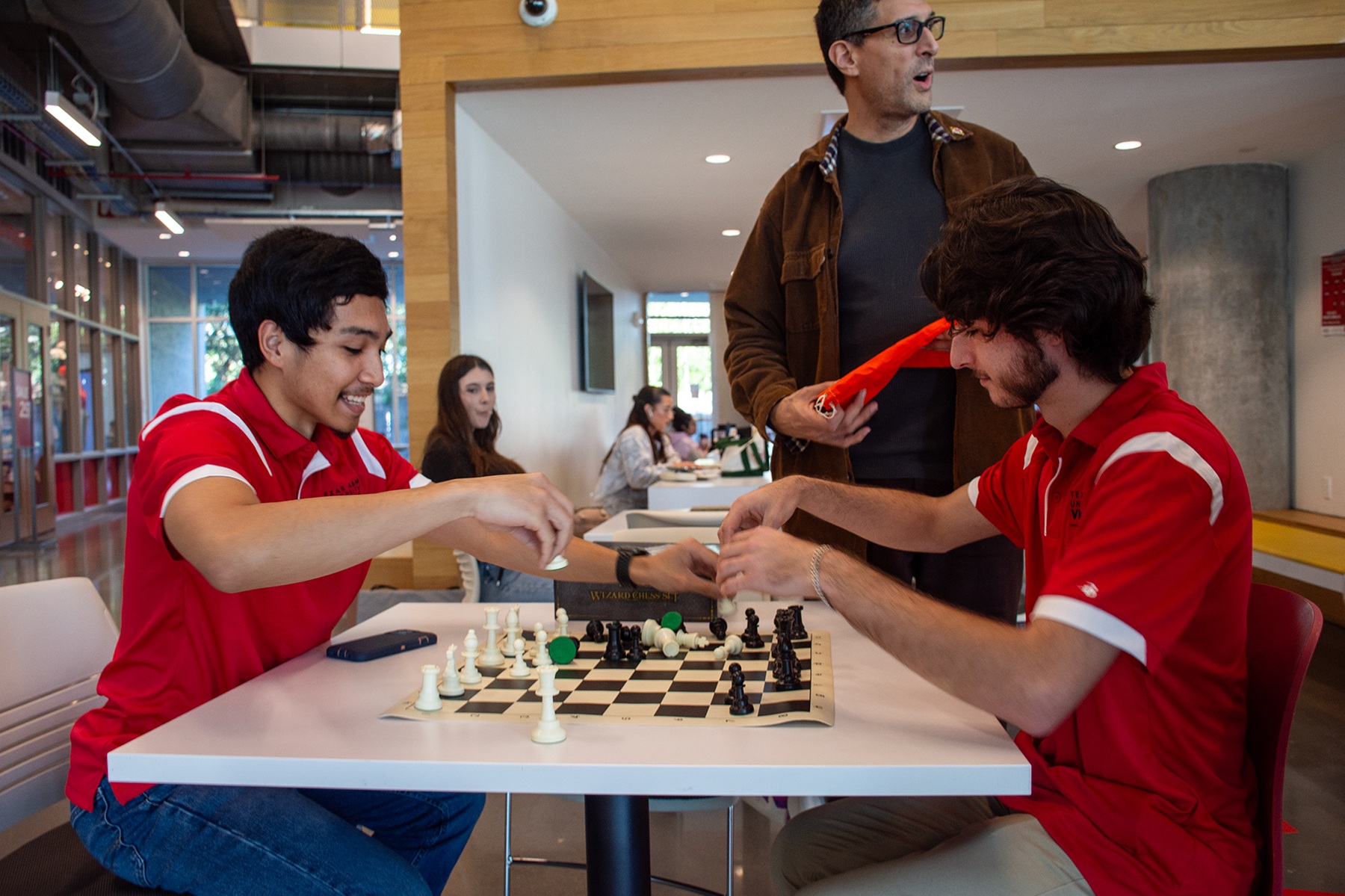
Jason Arrieta scanned the chess board, looking at his perfectly placed pieces staring into a horde of the black army opposite his.
Sixty-four black and white squares. Endless possibilities.
Around them, the university carried on with its usual business. But here, on the first floor of University Commons at Texas A&M University-Victoria on a Thursday afternoon, a small unofficial student chess club had made a world of its own.
“The King’s Gambit is a fun opening because if your opponent isn’t aware of your ideas, then you can get a very pleasant position and a higher attacking game,” Arrieta said. “It’s definitely dubious at higher levels, for sure.”
Arrieta, a public health major entering his senior year, first learned chess from his father when he was just seven years old. As a child, he played in tournaments, but his interest in chess really took hold later on.
During the COVID-19 pandemic, chess videos became abundant on YouTube, and the accessibility of Chess.com helped draw him back to the game, Arrieta said. He now plays regularly and has a U.S. Chess Federation rate of about 1,000, give or take.
His approach to the board involves more patience than making flashy moves, he said. He describes himself as a positional player who looks to make steady, improving moves and is always on the lookout for opportunities to emerge on the chess board.
Arrieta said he found the chess gathering after noticing the numerous boards scattered across tables inside University Commons at a previous meeting. Intrigued, Arrieta said he made a note to stop by at the next one.
“Playing chess in-person is way different than playing chess online; there’s a real sense of community,” Arrieta said. “It doesn’t matter what age you are, you can show up and be a baller.”
The game on Thursday afternoon began, as many games do, with an exchange of courtesies – players shake hands and jokes are exchanged. Now, it was off to battle.
He advanced his king’s pawn to e4; black answered in kind moving a pawn to e5. Across the board, the two students settled into a type of silence that seemed to suggest the smallest of movements, or lack of movement, could drastically shift the game.
Arrieta played the King’s Gambit opening. From there, pieces made their moves. Possibilities began to narrow, as the board slowly became a place of diminishing freedoms for both players.
By the time Arrieta’s white queen arrived at g5, staring directly at the king standing on g8, there was simply nowhere left for black’s king to go, no defenders that could come save him.
Checkmate.
Anthony Madrid, associate professor of English and creative writing, who also serves as the organization’s mentor, said the origin of the club dates back years ago to when he asked his class a question: did anyone wanted to learn how to play chess?
One student took the offer, wanting to learn so they could beat their younger brother, who always won their games, Madrid recalled. Madrid then began offering one-on-one training sessions, teaching what he calls “discussion games.” Rather than trying to win, he would guide learners through their moves and ask them to rationalize their choices.
Now roughly in its third year, the club remains informal, but the discussion games still continue for him. Meeting days and times can change each semester based on the schedules of regular attendees, Madrid said. This semester, the group meets Thursdays at 3 p.m. inside University Commons. Gatherings commonly last until six or seven in the evenings, and word of mouth is the main way attendees have been staying informed, he said.
The club’s informal status avoids the administrative work of registering as an official student organization, which would require officers and participation in Student Government Association processes, but the organization is open to the possibility of making its status official in the future, Madrid said.
The club is especially welcoming to people who are new at chess, and he takes great delight in helping beginners move from learning how the pieces work to playing with confidence, he said. At meetings, there is a mixture of beginners all the way up to advanced players. The meetings are open to all students, faculty and staff members.

“There are people who attend because they like gladiatorial combat, and you can get that from the chess club,” Madrid said. “But if you want a gentle atmosphere to learn, you can get that as well, this club is for everyone.”
For one of the members, Suebella Hobbins, her chess journey began in eighth grade after accidentally wandering into a room full of chess players. Now a freshman at A&M-Victoria studying nutrition, she has found a home in the campus chess meetups.
To maintain her skills, Hobbins practices online and has developed a particular playing style built upon surprising, and sometimes frustrating, her opponents, she said. Chess, to her, keeps her mind engaged in a way other games don’t.
For Noe Figueroa, the recent chess match against Arrieta did not go according to plan. He had hoped to move his queen toward the left side of the board, where he saw an opening in Arrieta’s position.
But Arrieta noticed and defended that side well, and Figueroa lost pieces trying to force the attack, Figueroa said. And once the plan fell apart, there wasn’t a chance to recover.
This chess match was one of many over the course of Figueroa’s chess journey, which began during his junior year of high school. After noticing a group of peers playing chess during an advisory period, Figueroa said he decided to learn.
At first, he struggled, but he improved quickly the following year after spending many of his class periods playing and practicing, he said.
Figueroa, a senior majoring in digital gaming and simulation, has also tried variants of the game such as atomic chess and fog chess. Those versions gave him a deeper insight into the game, but returning to standard chess took some adjustment. He decided to attend a meeting after Arrieta suggested they go together, and was surprised to find a community of players there, he said.
After seeing his friend, Arrieta, bring out his knight in the early game, he decided to mirror it to develop his own pieces, and hoping it will give him a defensive foundation. While the queen is arguably the strongest piece on the board, wielding the most power and offering the longest range, Figueroa said he’s found a lesser-known favorite piece.
“Most people love the queen, and I do too, but the knight is such a unique piece,” Figueroa said. “The way the knight moves is tricky – unpredictable – and unpredictable is dangerous in chess.”
For more information, or questions about the club, please contact Madrid at madrida@tamuv.edu.
Texas A&M University-Victoria, located in the heart of the Coastal Bend region since 1973 in Victoria, Texas, offers courses leading to more than 50 academic programs in the colleges of Business, Education & Health Professions, Liberal Arts & Social Sciences, and Natural & Applied Science. A&M-Victoria provides face-to-face classes at its Victoria campus, as well as online classes that students can take from anywhere. The university supports the American Association of State Colleges and Universities Opportunities for All initiative to increase awareness about state colleges and universities and the important role they have in providing a high-quality and accessible education to an increasingly diverse student population, as well as contributing to regional and state economic development.