
Luncheon welcomes retired faculty, staff back to campus
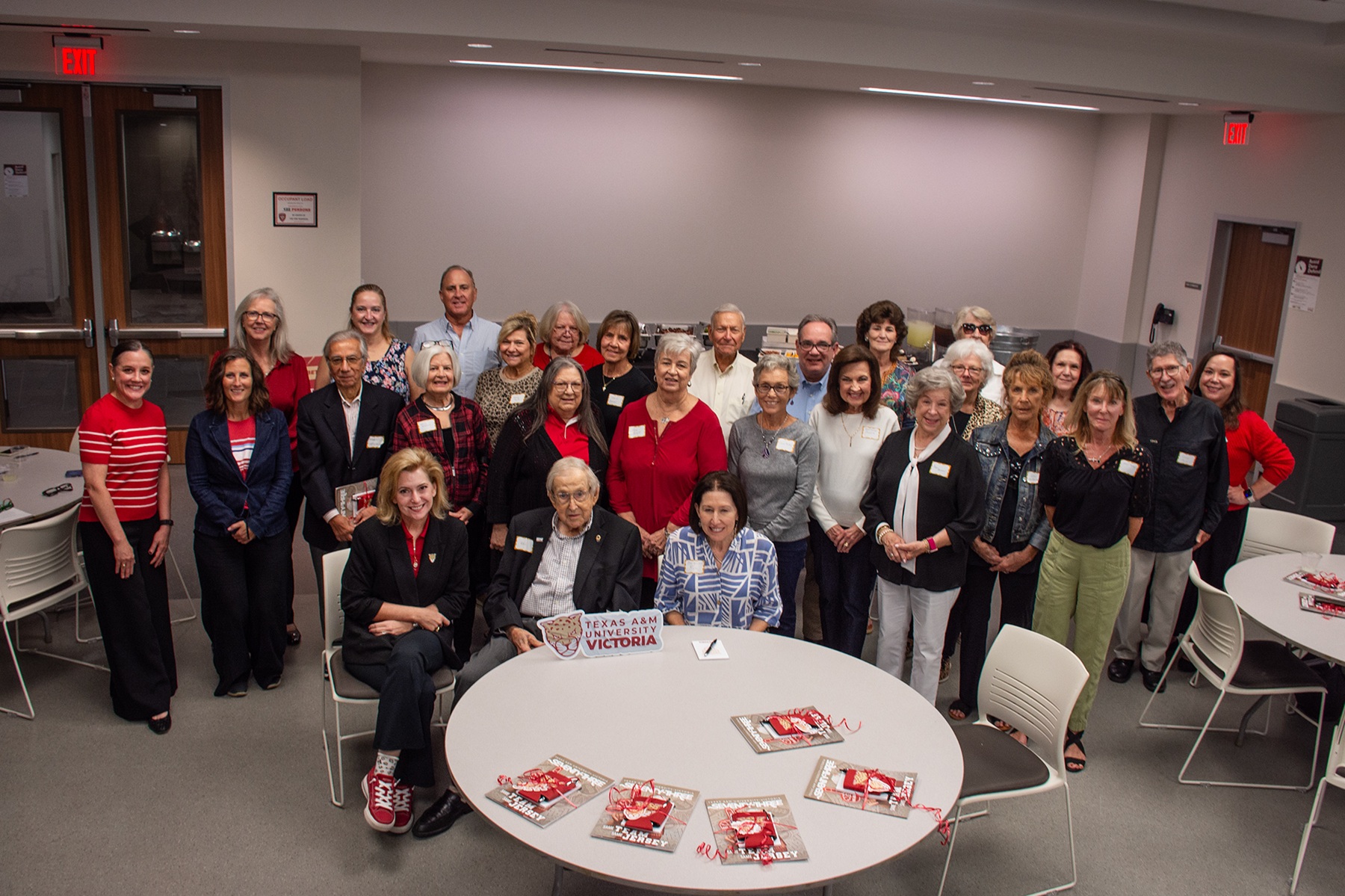
As part of Texas A&M University-Victoria’s Homecoming festivities, retired faculty and staff members returned to campus for a special lunch celebrating the connections and memories that continue to reunite the Jaguar community.
Held on Wednesday, Oct. 21, the Retired Faculty and Staff Luncheon invited former colleagues into University North to reconnect, reminisce and catch up over lunch while hearing updates from university administrators on the institution’s priorities, accomplishments and direction.
Guests were treated to a loaded baked potato lunch capped off with a flourless chocolate tart for dessert. They were officially welcomed by Amber Countis, vice president for advancement and external relations, before A&M-Victoria President Christian Hardigree took to the lectern.

“We are so excited to have you back on our campus. I can feel the energy, and I really appreciate you taking the time to be here today,” President Hardigree said. “You all played a part in bringing higher education to this region for over 50 years, and it is because of the work of the people in this room that we are where we’re at.”
During the luncheon, President Hardigree updated the guests on the period of change the institution has gone through, shaped by new system priorities, leadership appointments, construction projects and a push to strengthen the student experience.
Academic quality is also at the center of a broad set of changes underway in Academic Affairs, noted Alyssa Kiesow, provost and vice president for Academic Affairs.
Academic leaders are emphasizing engaging instruction, consistent course expectations and ongoing reflecting on teaching, Kiesow said. At the same time, the institution is reviewing its academic offerings and consulting with community partners to identify areas of need. The effort also includes investing in learning resources and building leadership and support needed to sustain the work, she said.
For Cheryl Robbins, after 22 years at the university, she has seen it grow from a small institution into a four-year university.
When Robbins began working at the university in 2000, it was a much smaller place, she said. Over the next two decades, she moved among departments, took on new responsibilities and watched as the institution expanded.

“I look back on it and think of all the different changes we’ve had,” Robbins said. “And they’ve been all for the good; each change through a better environment.”
She started as a temporary employee in the Provost Office. Her career then took her through the Center for Nonprofit Leadership, Distance Education, Social Work, International Programs, Regional Outreach and Business Services. For most of that time, she served as a senior secretary.
After leaving the university for a period, Robbins returned to work full time in Housing, where she spent 10 years before retiring. In July 2025, she returned to the university part time again working in Housing, where she found a different type of connection, she said. In her role, she had found more opportunities to interact with students, and those encounters have become some of her favorite memories.
Looking back, Robbins said she is proud to have been a part of the institution’s history, especially its expansion and the progress that followed.
Texas A&M University-Victoria, located in the heart of the Coastal Bend region since 1973 in Victoria, Texas, offers courses leading to more than 50 academic programs in the colleges of Business, Education & Health Professions, Liberal Arts & Social Sciences, and Natural & Applied Science. A&M-Victoria provides face-to-face classes at its Victoria campus, as well as online classes that students can take from anywhere. The university supports the American Association of State Colleges and Universities Opportunities for All initiative to increase awareness about state colleges and universities and the important role they have in providing a high-quality and accessible education to an increasingly diverse student population, as well as contributing to regional and state economic development.