
Texas 250 exhibit invites community to walk through history at A&M-Victoria
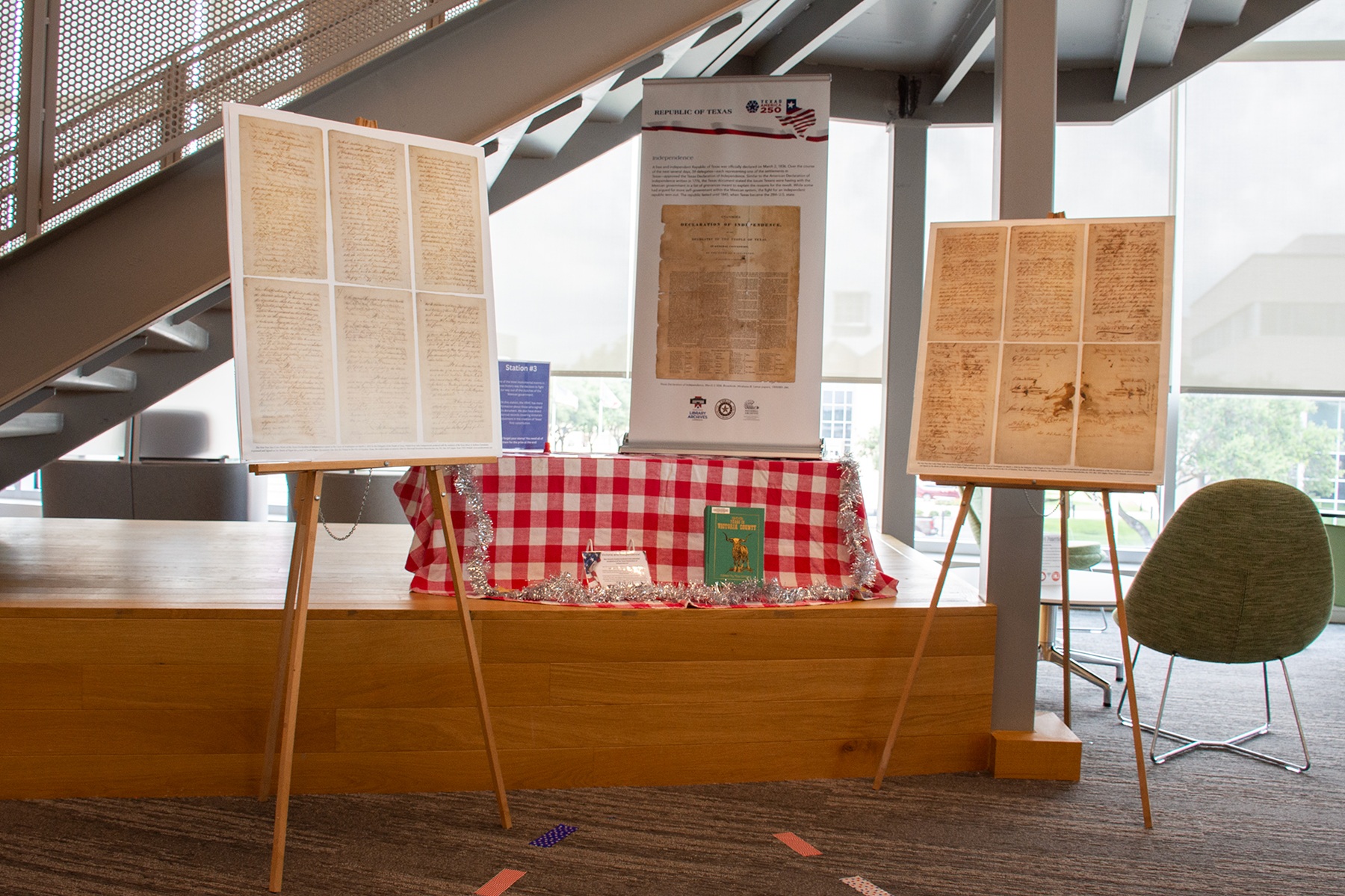
Texas A&M University-Victoria has transformed its Library spaces into an immersive history experience that connects national milestones to Victoria’s own past.
The new exhibit, “Texas 250: A Walk Through History,” is officially open and is planned to run through the first week of August, inviting visitors through five stations spread across the A&M-Victoria Library located in University Commons, 3006 N Ben Wilson St.

“I’m a Texas history person and my dad’s a Texas history person,” said Miriam Sliva, A&M-Victoria instruction and outreach librarian. “I hope people walk away from this exhibit with a deeper understanding of the role Texas has played in America being the country that it is.”
Open to the public, the exhibit invites students, faculty, staff and community members to explore how Texas helped shape the United States and how Victoria contributed to that story.
The exhibit began when the Texas State Archives sent a set of five professionally produced display panels to the Victoria Regional History Center as part of the broader America 250 commemoration, said A&M-Victoria archivist Mia Campbell. The display panels trace key moments across 250 years of Texas history, from early settlement and revolution to statehood and the modern era.
Through collaboration with Sliva, rather than simply mounting the panels in a single spot, they decided to turn the materials into a full library experience, Campbell said. The five-station walking tour will thread through the entire building and layers in local archival materials and library resources at every stop.

As a designated regional historical resource repository for the Texas State Archives, the Victoria Regional History Center already preserves significant records documenting South Texas and Victoria’s role in the state’s development. The exhibit builds on that responsibility by placing Victoria’s stories alongside the broader Texas narrative, Campbell said.
Some of the materials guests can expect to see are historical maps of Victoria from the 1920s and 1940s, allowing them to see how the city’s streets and neighborhoods have evolved over time. Additionally, guests can get a glimpse into Texas independence-era documents, including reproductions of the Texas Declaration of Independence and contextual information about how Victoria residents participated in the independence movement.
To make the exhibit more engaging, the library has also created an interactive stamp tour. Visitors can pick up a map and instructions at the front entrance and circulation desk located in the library. Each station will include a stamp, and visitors mark their progress by stamping the corresponding circle on the map. Those who visit all five stations and collect every stamp can return to the library staff to receive a free goodie bag.
“We are the oldest continuous constitutional democracy in the world, and that is very significant,” Campbell said. “Part of the reason why I wanted to implement so much of Victoria and South Texas history into this exhibit is so people can know that they played a part in the history of Texas and in the history of America as a whole.”
Texas A&M University-Victoria, located in the heart of the Coastal Bend region since 1973 in Victoria, Texas, offers courses leading to more than 50 academic programs in the colleges of Business, Education & Health Professions, Liberal Arts & Social Sciences, and Natural & Applied Science. A&M-Victoria provides face-to-face classes at its Victoria campus, as well as online classes that students can take from anywhere. The university supports the American Association of State Colleges and Universities Opportunities for All initiative to increase awareness about state colleges and universities and the important role they have in providing a high-quality and accessible education to an increasingly diverse student population, as well as contributing to regional and state economic development.