
Two hats, one community: A&M-Victoria alumnus serves through leadership
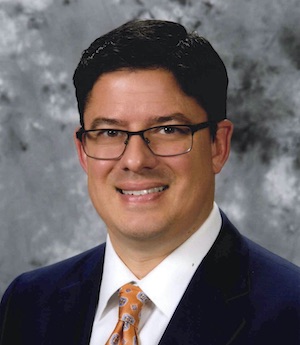
Texas A&M University-Victoria alumnus Lance Smiga has two important titles: Mayor of Edna and chief executive officer of the Jackson County Hospital District, but he prefers to be known simply as Lance.
He wears the two hats with conviction, as someone who has lived his whole life in Edna, and intends to give back to the place that raised him. This was the place where his children grew up, where pride in community matters as much as any policy.
Initially, he took his first college steps at Victoria College, where he studied for two years before transferring over to Texas A&M University. He earned a Bachelor of Business Administration in finance in 1997. Later on in his life, Smiga become a Jaguar and earned a Master of Business Administration from A&M-Victoria in 2016.

“I am tremendously proud to see one of our alumni rise to such a level to serve our local community," said Xavier Garza-Gomez, interim dean of the College of Business. "His career reflects the very mission of our college, to prepare principled, forward-thinking leaders who apply sound business judgment in service of others. Lance represents the best of our alumni, and we are honored to call him one of our own."
After he graduated from Texas A&M, Smiga entered the workforce with H&H Overhead Company Inc. in Victoria, but a chance opportunity pulled him into the world of healthcare. He initially entered healthcare as a business office assistant in a nursing home and, over the next 13 years, climbed the ranks to business office manager, nursing home administrator and ultimately vice president of operations. Those years taught him the nuts and bolts of running care facilities and introduced him to the deep personal rewards of serving patients and families, he said.
“I had always wanted to move up the ladder when it comes to management and healthcare,” Smiga said. “My ultimate goal was to work at the hospital in my hometown.”
By 2010, Smiga had returned home to Edna with his family to search for roles closer to where he grew up. In 2011, he became chief financial officer of the Jackson County Hospital District and settled his family back into the community. With the responsibilities that come with taking care of a family, as well as a full-time job, Smiga knew the road to advancing his education would be difficult. However, with a deep desire to advance his healthcare career and meet formal qualifications for senior leadership roles, he took the plunge.
“It offered me the flexibility to go back to school,” Smiga said. “As a husband and father of four, I needed flexibility and it offered that opportunity. It had always been a dream, and I want to go back and continue my education.”
The flexibility of the business program at A&M-Victoria came in the form of online courses, which proved to be a better fit for all the rhythms of his life, he said.
“Once the kids went to bed at nine, I was able to sit down in front of the computer and complete the coursework,” Smiga said. “I found it very rewarding. Being able to communicate with other people who were in a similar situation like me, and those who just graduated and were working on their master’s right away, it gave me a lot of different perspectives.”
Shortly before finishing his MBA, Smiga entered local politics. He ran for city council and won a seat in 2016, driven less by ambitions than by a desire to give back to Edna, he said. By May of 2019, he had been elected as the city’s mayor. Serving on council and then as mayor deepened his engagement with municipal issues such as draining, trash service and property upkeep.
His roles in healthcare administration and city government eventually came together. As CEO of the Jackson County Hospital District and Mayor of Edna, Smiga said he finds the two roles complementary. During the COVID-19 pandemic, that overlap allowed him to coordinate responses and communicate consistent guidance across the hospital and city, he said.
A typical day of his life reflects the dual commitment to his jobs. He spends the morning hours at the hospital, then has a quick lunch at home, followed by afternoon check-ins with the city manager before going back to the hospital and then attending either hospital or city meetings well until 8 p.m.
“If you love what you do, it’s not a problem,” Smiga said. “Whenever I get a phone call, my first question to most people is, ‘Which hat am I putting on now?’”
Throughout the course of his career, Smiga said he makes it a priority to keep an eye on local talent. He encourages students from A&M-Victoria and beyond to consider local healthcare careers and to consider picking up the phone and making a call if they have any questions. For him, the university is more than a credential provider, it’s a pipeline of people who can strengthen local institutions and grow into leadership roles, he said.
His advice to students and aspiring leaders echoes his own journey. Stay open to opportunities, be willing to pivot when chance and passion intersect, and choose work you care about rather than just chasing dollars or titles, he said. His entry into healthcare was unexpected, but continued education and an open mind let it become a calling.
“I hope that when my time is over, people will look back and think the city is in a better position than it was the day I took office,” Smiga said. “It’s really that simple.”
Students who have questions about the healthcare industry or need advice can contact the Jackson County Hospital District office line at 361-782-7852.
Texas A&M University-Victoria, located in the heart of the Coastal Bend region since 1973 in Victoria, Texas, offers courses leading to more than 50 academic programs in the colleges of Business, Education & Health Professions, Liberal Arts & Social Sciences, and Natural & Applied Science. A&M-Victoria provides face-to-face classes at its Victoria campus, as well as online classes that students can take from anywhere. The university supports the American Association of State Colleges and Universities Opportunities for All initiative to increase awareness about state colleges and universities and the important role they have in providing a high-quality and accessible education to an increasingly diverse student population, as well as contributing to regional and state economic development.