
Victoria County approves $50,000 for aviation, agribusiness scholarships
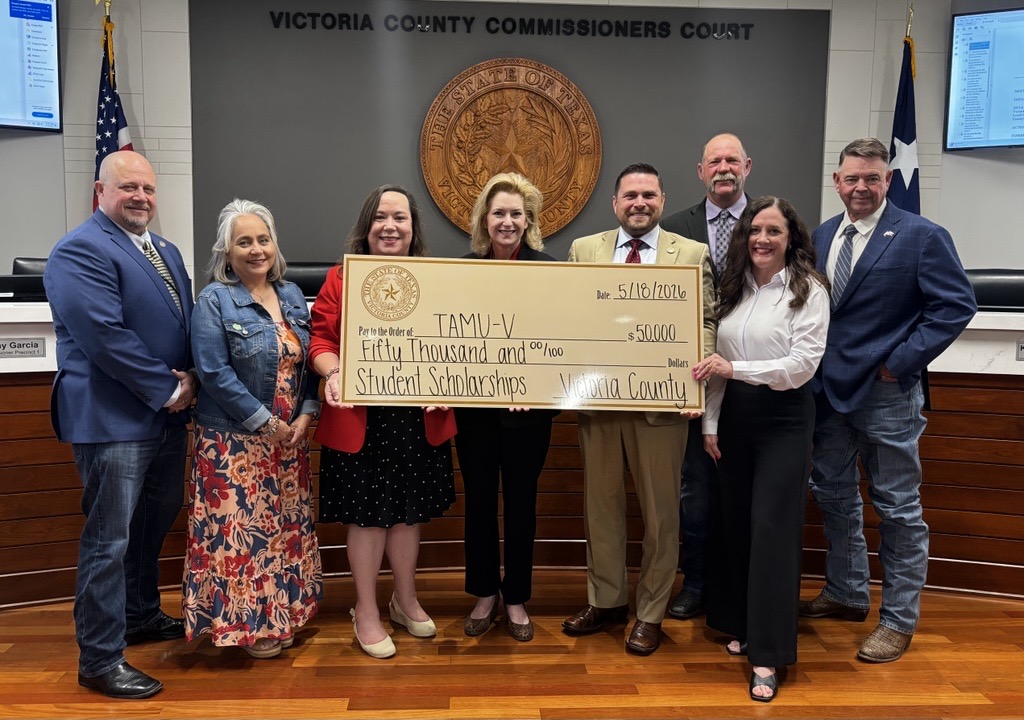
Students from Victoria County who plan to study aviation and agribusiness will have access to scholarship funds, thanks to a Chapter 381 Economic Development Agreement between Victoria County and Texas A&M University-Victoria.
Through this agreement, Victoria County Commissioners Court made a commitment to gift $50,000 in Capital Credit Funds to A&M-Victoria during its Monday meeting to create two endowed scholarships for aviation and agribusiness programs. The purpose of the scholarships is to reinforce economic development for the region by encouraging local students to earn their degrees in Victoria.
“We are very grateful for the ongoing support and for the county taking the lead in supporting these new programs,” said Amber Countis, vice president for advancement and external relations. “This is a perfect synergy for the university and the county. The county has supported this new era for the university and is leading the way in investing in higher education. We hope to have many more supporters follow their example.”
Because the scholarships are endowments that will be self-sustaining, the funds will be allowed to accrue some interest before the first scholarships are awarded. The funds come from Capital Credit Funds, which are unclaimed capital credits that are allocated to the county through the state comptroller’s office.
The Capital Credit Funds have specific limits and criteria for how they can be spent, but one of the main uses is to invest in economic growth opportunities, said Ben Zeller, Victoria County Judge. The scholarship commitment is an opportunity to dedicate external funds that did not come directly from local taxpayers to targeted investments in programs that can promote growth in two specific economic areas of the county.
As an alumnus of A&M-Victoria and a member of the university’s President’s Regional Advisory Board, Zeller knows firsthand how a higher education from A&M-Victoria can benefit a person and create opportunities for them. He and other county representatives hope to create that same benefit for future generations of students.
“We’re excited about this opportunity to further our partnerships with the university and support higher education options for our local students,” Zeller said. “As an alumnus of both A&M-Victoria and Texas A&M University-San Antonio, I’ve been proud to support the transition into The Texas A&M System, and I want to continue to support the university’s success. Victoria County is ready to work hand-in-hand with the university to build a framework for future success.”
Texas A&M University-Victoria, located in the heart of the Coastal Bend region since 1973 in Victoria, Texas, offers courses leading to more than 50 academic programs in the colleges of Business, Education & Health Professions, Liberal Arts & Social Sciences, and Natural & Applied Science. A&M-Victoria provides face-to-face classes at its Victoria campus, as well as online classes that students can take from anywhere. The university supports the American Association of State Colleges and Universities Opportunities for All initiative to increase awareness about state colleges and universities and the important role they have in providing a high-quality and accessible education to an increasingly diverse student population, as well as contributing to regional and state economic development.